Tuesday, September 10, 2013

Work carried out on lump sum basis does not falls under supply of manpower services


We are sharing with you an important judgement of the Hon’ble CESTAT in the case of M/s. Shri Bileshwar Khand Udyog Sahakari Mandali Limited Vs. CCE [(2013) 36 Taxmann.com 8 (Ahmedabad - CESTAT)] on the following issue:
Issue:
Whether work carried out on lump sum basis as a contractor, exigible to Service Tax under the Supply of Manpower Services?

Facts & Background:

M/s. Shri Bileshwar Khand Udyog Sahakari Mandali Limited (“the Appellant” or “the Co-operative Society”) is a sugar co-operative society of farmers.

The farmers of the area, after cultivating the crop of sugarcane, are supplying the said sugarcane to the Appellant's factory for producing sugar.  Further the Appellant pays the farmer, a specified amount as per metric tonne for the cost of sugarcane procured by them.

The farmers were facing difficulty in arranging the labourer to cut the sugarcane crop, load the same into the trailer, unload it and put the same in sugar factory and accordingly had approached the Appellant for solving their problem. Since the farmers were facing difficulty in arranging the labourers to carry out the above work, the Co-operative Society on request of the farmers had got in touch with various labourers to cut sugarcane crop, load same into trailer, unload it and put it in its sugar factory.

The Appellant was paying price for purchase of sugarcane after deducting Rs. 300 per MT for work done by it i.e. charge of the labours paid by the Co-operative Society.

The Department argued that Rs. 300 per MT was sum (consideration) towards manpower supply agency services provided by the Appellant to farmers.

The Appellant contended that

·         The Appellant are not supplying any labour. Further the Co-operative Society is charging an amount as lump sum amount from the farmers.

·         An identical issue has been decided by the Bench in the case of K. Damodarareddy Vs.CCE [2010] 25 STT 69] {“ K. Damodarareddy Case”} wherein it has been held that when there are multiple services included and the charges are lump sum charges, it could not be covered under the category of man power recruitment or supply agency services. Also the same view has been reiterated by the Tribunal in the case of Ritesh Enterprises Vs. CCE [(2010) 24 STT 283] {“Ritesh Enterprises Case”}.

·         The farmers of the area are the members of the Appellant's sugar factory and hence they cannot be identified separately, which would result in the proposition that the Appellant is rendering the services to himself and the said services cannot be considered as services rendered to his clients.

Held:

The Hon’ble CESTAT granted stay to the Appellant and all the applications for waiver of pre-deposit of the amounts involved are allowed and recovery thereof stayed till the disposal of appeals. In the instant case, the Hon’ble CESTAT observed the following:
Ø  The Appellant has arranged for cutting of sugarcane crop from the field of farmers who are their members.

Ø   As evident from invoices the Appellant is charging lump sum amount of Rs.300/- per metric tonne for the help provided by them to farmers for cutting, loading and unloading of sugarcane from the field of farmers.

Ø  Relied on decision in case of K. Damodarareddy Case and Ritesh EnterprisesCase. In both these cases, the issue involved was identical except that bagging of cement, loading and unloading of the cement exist instead of sugarcane.

For your reference brief of the above relied on cases are as under:
K. Damodarareddy Case:
Under a contract with a cement company, the Assessee carried out activities of loading of cement bags into closed wagons, cleaning, sealing and riveting, etc., wagon door complete spillage recovery of total quantity, drawing of bags to stenciling floor, and wagon door opening/wagon cleaning - It was compensated for different items of work at separate rates prescribed in contract. The Assessee did not supply manpower or charge for labour provided on man-day basis or man-hour basis and carried out work as a contractor employing its own labour. The CESTAT held the Assessee carried out the work as a contractor employing its own labour is not classifiable as ‘Manpower recruitment or supply agency’.
Ritesh Enterprises Case:
The Assessee entered into a contract with different part for lump sum cargo handling for granite export and also for the purpose of rendering services of handling of bulk goods, bagging of fertilizers, feeding of bags for filling of fertilizers, stacking, destacking, etc. The Adjudicating Authority concluded that the above services rendered by the Assessee would fall under the category of ‘Manpower recruitment or supply agency’ in terms of Section 65(68) of the Finance Act,1994 (“the Finance Act”)  while the Assessee submitted that the contract in question was a works contract and not for supply of labour.

The Hon’ble CESTAT held that the Assessee were intimated about the berthing of vessels at various ports and they were given a lump sum contract for cargo handling, i.e., loading and unloading of the goods into the said vessels. Further, the invoices issued by the Assessee showed that they were raised for ‘cargo handling for granite export and loading of Indian rough granite blocks’ for a lump sum amount, charged per Metric Tonne.
The contract which had been given to the Assessee was for the execution of the work of loading, unloading, bagging, stacking, destacking, etc. Further, in the entire records, there was no whisper of supply of manpower to the concerned parties or any other recipient of the services. It was clear from the contracts and the invoices issued by the Assessee that the entire essence of the contract was an execution of work as understood by the Assessee and the recipient of the services. Further the entire tenure of the agreement and the purchase orders issued by the service recipient clearly indicated the execution of a lump sum work. That lump sum work would not fall under the category of providing of service of ‘supply of manpower temporarily or otherwise either directly or indirectly’.
Conclusion:

In view of above case laws, it can be concluded that no service tax is payable on work carried out on lump sum basis does not amount to manpower supply services.

POINTS TO REMEMBER:

Ø  Prior to July 1, 2012, Manpower Recruitment or Supply Agency was exigible to service tax as being a taxable service defined under Section 65(68) and under Section65(105)(k) of the Finance Act respectively, which are reproduced as under:

Section 65(68) of the Finance Act with effect from May16, 2008 provides as under:

Manpower Recruitment or Supply Agency means any person engaged in providing any service, directly or indirectly, in any manner for recruitment or supply of manpower, temporarily or otherwise, to any other person.

Section 65(105)(k)of the Finance Act with effect from May 16,2008 provides as under:
Taxable service means any service provided or to be provided to any person, by a manpower recruitment or supply agency in relation to the recruitment or supply of manpower, temporarily or otherwise, in any manner;
Explanation. — For the removal of doubts, it is hereby declared that for the purposes of this sub-clause, recruitment or supply of manpower includes services in relation to pre-recruitment screening, verification of the credentials and antecedents of the candidate and authenticity of documents submitted by the candidate”
Ø  With effect from July 1, 2012, Section 65(68) and under Section65(105)(k) rescinded and new definition of supply of Manpower inserted under Rule 2(1) (g) of the Service Tax Rules, 1994 (“the STR”), which is reproduced here in below:

Supply of Manpower means supply of manpower, temporarily or otherwise, to another person to work under his superintendence or control.”
Difference between Old definition and New Definition of Supply of Manpower:
There is specific departure of Manpower recruitment, which is not included in the new definition and any supply of manpower, temporarily or otherwise, in any manner was covered in erstwhile definition where as new definition is very specific i.e. Supply of Manpower means supply of manpower, temporarily or otherwise, to another person to work under his superintendence or control.
In view of above definition, where supplied manpowers are working under supervision or control of service recipient then it will fall under the ambit of “Supply of manpower” and thus exigible to service tax under the stated category. 
Supply of Manpower is one of the categories under Partial Reverse charge w.e.f 1-7-2012:
In certain specified circumstances, both service provider and service recipient would be liable to pay service tax in specified percentage under partial reverse mechanism in terms of Rule 2(1)(d) of the STR read with Notification No. 30/2012-ST dated June 20, 2012 (“the Notification”) as under:-
S.No
 Description of a service
 Percentage of service tax payable by the service provider
Percentage of service tax payable by the service recipient
8
Supply of Manpower Services for any purpose provided or agreed to be provided by an any individual, HUF or partnership firm, whether registered or not, including AOP, located in the taxable territory to a business entity registered as body corporate, located in the taxable territory
25%
75 %

Hope the information will assist you in your Professional endeavours. In case of any query/ information, please do not hesitate to write back to us.

Thanks & Best Regards

Bimal Jain
FCA, FCS, LLB, B.Com (Hons)
Mobile: +91 9810604563
E-mail: bimaljain@hotmail.com
Released a Book - "Guide to Service Tax Voluntary Compliance Encouragement Scheme, 2013", authored by Bimal Jain, FCA, FCS, LLB

Disclaimer: The contents of this document are solely for informational purpose. It does not constitute professional advice or recommendation of firm. Neither the authors nor firm and its affiliates accepts any liabilities for any loss or damage of any kind arising out of any information in this document nor for any actions taken in reliance thereon.

Readers are advised to consult the professional for understanding applicability of this newsletter in the respective scenarios. While due care has been taken in preparing this document, the existence of mistakes and omissions herein is not ruled out. No part of this document should be distributed or copied (except for personal, non-commercial use) without our written permission.

Saturday, September 7, 2013

Indigo hikes flights rates by 25 percent.

New Delhi: Domestic carrier IndiGo on Friday followed its rivals and raised airfares by 25 per cent. IndiGo joins airlines such as SpiceJet, Jet Airways and Air India who recently hiked the fares by 25 per cent citing rise in input costs.
"IndiGo has revised upwards its fares, which are now 25 per cent higher than earlier," a source in the budget carrier said here. When contacted, the Gurgaon-based airline declined to comment on the issue.
There has been a 7 per cent increase in the jet fuel prices. This is due to the falling rupee and rise in international crude prices.
Incidentally, none of the airline has so far issued any official statement on the hike, in sharp contrast to ad blitzkrieg they resort to when they announce special low fares. They have declined to take media queries on the issue. "We are restoring the fares to the normal levels which existed in June," Air India sources said earlier, adding, the decision was a fallout of increase in jet fuel prices.
International oil prices have been trading between USD 105 and USD 115 a barrel since the past few months and the uptrend is influenced by the Syrian crisis. Jet fuel prices were hiked by a steep 6.9 per cent, taking the rate to Rs 75,031 per kilolitre, from September 1.
This came on the back of two rounds of ATF price hikes effected in July and August by oil marketing companies. ATF prices were increased by 5.8 per cent on July 1 and by another 6.3 per cent on August.

Thursday, September 5, 2013

Pension Bill: Key Highlights

A key economic reforms legislation, the Pension Bill, that provides for investment of funds in equity market and opens the sector to at least 26 per cent FDI was on Wednesday passed by the Lok Sabha.

• The subscriber seeking minimum assured returns shall be allowed to opt for investing his funds in such scheme providing minimum assured returns.

• Withdrawals will be permitted from the individual pension account subject to the conditions, such as, purpose, frequency and limits, as may be specified by the regulations.

• At least one of the pension fund managers shall be from the public sector.

• To establish a vibrant Pension Advisory Committee with representation from all major stakeholders to advise PFRDA on important matters of framing of regulations under the PFRDA Act.

• It will have provision for withdrawals for limited purposes from Tier-I pension account, an incentive for subscribers to join the New Pension Scheme (NPS).

• The corpus of the NPS having 52.83 lakh subscribers (including those of 26 state governments) was about Rs 35,000 crore.

• The bill also seeks to grant statutory status to the Pension Fund Regulatory and Development Authority.

Source:- NDTV(Media)

Assessee not expected to verify with Department in order to avail Cenvat credit, whether supplier had paid duty on inputs or not.


We are sharing with you an important judgement of the Hon’ble Supreme Court of India, in the case of Commissioner of Central Excise, Jalandhar vs. M/s. Kay Kay Industries [AIT-2013-147-SC] on following issue:

Issue:

Whether the assessee is expected to verify with Department whether supplier had paid duty on inputs supplied by Manufacturer-Supplier in order to avail deemed MODVAT credit?

Facts & Background:

M/s Kay Kay Industries (“the Respondent” or “the assessee”) availed deemed MODVAT credit of Rs. 77,546/- during the quarter of March, 2000 on the strength of invoices issued by M/s. Sawan Mal Shibhu Mal Steel Re-Rolling Mills, Mandi Govindgarh, supplier of inputs. During MODVAT verification it was found that the supplier of inputs had not discharged full duty liability for the period covered by the invoices on the strength of which the Respondent took the benefit of deemed MODVAT credit. The Competent Authority was of the view that it was obligatory on the part of the Respondent to take all reasonable steps to ensure that the appropriate duty of excise had been paid on the inputs used in the manufacture of their final product as required under Rule 57A(6) of the Central Excise Rules, 1944 (“the Rules”) read with notification No. 58/97-CE(NT) dated 30.8.1997 (“the  notification”) and issued a show-cause notice on 19.1.2001 proposing recovery of deemed MODVAT credit of Rs. 77,546/- and imposition of penalty. The adjudicating authority, after receipt of the reply to the show-cause notice, by order dated 22.3.2002, disallowed the deemed MODVAT benefit availed earlier and ordered for recovery of the said sum along with interest, and, further imposed penalty of Rs. 40,000/-.

Being aggrieved by the aforesaid order the Respondent preferred an appeal before the Commissioner (Appeals), Central Excise, Jalandhar, who concurred with the view taken by the adjudicating authority. However, it reduced the penalty from Rs. 40,000/- to Rs. 20,000/-. Thereafter, the Respondent preferred an appeal before the Customs, Excise and Service Tax Appellate Tribunal (“the Tribunal”) who quashed the orders passed by the adjudicating authority and that of the appellate authority.

Questioning the justifiability of the aforesaid order, Revenue preferred an appeal before the High Court who concurring with the view expressed by the Tribunal dismissed the appeal. Hence, the Revenue preferred an appeal before the Hon’ble Supreme Court.

Held:

It was held by the Hon’ble Supreme Court that Rule 57A (6) of the Rules postulates and requires “reasonable care” and not verification from the Department whether the duty stands paid by the manufacturer-seller.

The Hon’ble Supreme Court held that there is no dispute that a declaration was given by the manufacturer of the inputs indicating that the excise duty had been paid on the said inputs under the Act.

It is also not in dispute that the said inputs were directly received from the manufacturer but not purchased from the market. There is no cavil over the fact that the manufacturer of the inputs had declared the invoice price of the inputs correctly in the documents.

Rule 57A (6) of the Rules requires the manufacturer of final products to take reasonable care that the inputs acquired by him are goods on which the appropriate duty of excise as indicated in the documents accompanying the goods, has been paid.

The notification has been issued in exercise of the power under the said Rule. The notification clearly states to which of those inputs it shall apply and to which of the inputs it shall not apply and what is the duty of the manufacturer of final inputs. Thus, when there is a prescribed procedure and that has been duly followed by the manufacturer of final products, it cannot be perceived that the assessee had not taken reasonable care as prescribed in the notification. Due care and caution was taken by the Respondent. It is not stated what further care and caution could have been taken.

Therefore, the Hon’ble Supreme Court dismissed the appeal and decided the case in favour of the Respondent.

Present Scenario under the Cenvat Credit Rules, 2004 (“the Credit Rules”):
As such there is no specific condition under the Credit Rules that the assessee has to verify with Department in order to avail Cenvat credit, whether supplier had paid duty on inputs supplied by Manufacturer-Supplier. Further, Sub rule (5) and (6) of Rule 9 of the Credit Rules, only specify that burden of proof lies on Manufacturer or Service Provider regarding admissibility of the CENVAT credit on Inputs, Capital Goods and Input Services as reproduced here in below:
“(5) The manufacturer of final products or the provider of output service shall maintain proper records for the receipt, disposal, consumption and inventory of the input and capital goods in which the relevant information regarding the value, duty paid, CENVAT credit taken and utilized, the person from whom the input or capital goods have been procured is recorded and the burden of proof regarding the admissibility of the CENVAT credit shall lie upon the manufacturer or provider of output service taking such credit.
(6) The manufacturer of final products or the provider of output service shall maintain proper records for the receipt and consumption of the input services in which the relevant information regarding the value, tax paid, CENVAT credit taken and utilized, the person from whom the input service has been procured is recorded and the burden of proof regarding the admissibility of the CENVAT credit shall lie upon the manufacturer or provider of output service taking such credit.”

Recently, the Hon’ble Delhi Tribunal in the case of CC & CCE Vs M/s Juhi Alloys Ltd (2013-TIOL-1310-CESTAT-DEL) has held that “A buyer can take steps which are in their control and he cannot be expected to verify the records of the supplier's broker (i.e dealer) to check whether in fact the supplier has paid duty on the goods supplied by him or not - as long as bonafide nature of the consignee transaction is not doubted, credit should not be denied - Revenue appeals rejected: CESTAT [paras 6, 7 & 8]:DELHI CESTAT”

Hope the information will assist you in your Professional endeavors. In case of any query/ information, please do not hesitate to write back to us.
Thanks & Best Regards.

Bimal Jain
FCA, FCS, LLB, B.Com (Hons)
Mobile: +91 9810604563
E-mail:
bimaljain@hotmail.com

Released a Book - "Guide to Service Tax Voluntary Compliance Encouragement Scheme, 2013", authored by Bimal Jain, FCA, FCS, LLB

Disclaimer: The contents of this document are solely for informational purpose. It does not constitute professional advice or recommendation of firm. Neither the authors nor firm and its affiliates accepts any liabilities for any loss or damage of any kind arising out of any information in this document nor for any actions taken in reliance thereon.

Readers are advised to consult the professional for understanding applicability of this newsletter in the respective scenarios. While due care has been taken in preparing this document, the existence of mistakes and omissions herein is not ruled out. No part of this document should be distributed or copied (except for personal, non-commercial use) without our written permission.
Monday, September 2, 2013

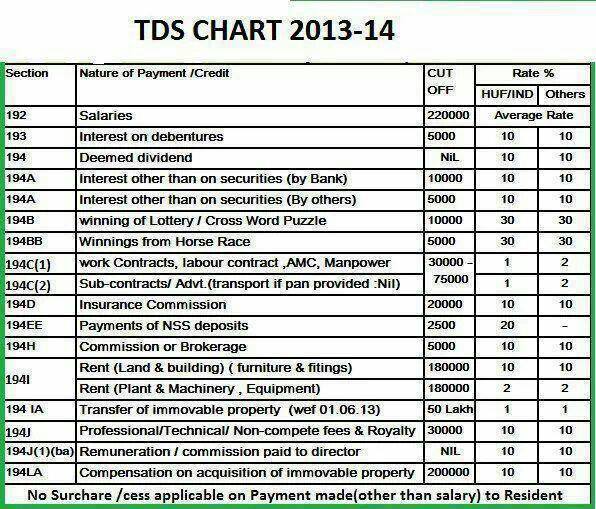
TDS CHART FOR 2013-2014


TAX AUDIT PROBLEMS AND SOLUTIONS by CA Nitesh More

TAX AUDIT PROBLEMS AND SOLUTIONS

TECHNICAL ISSUES
 

1. STEPS FOR FILLING ONLINE TAX AUDIT REPORT
 

Q1. What are the steps to be followed for E-filling of Tax Audit Report?
 

Ans. Step 1- One Time Registration of Chartered Accountant at E-filling website
Step 2 – Login to Assessee account at e-filling website and Add CA


Step 3 – Downloading, Preparing Tax Audit Report Utility & Generating XML file.
Step 4 – Uploading XML file at E-filling website from CA’s Login Id
Step 5 – Approval of form uploaded by CA at E-filling website from Assessee’s Login Id
Step 6 – Do not forget to file Income Tax Return in Relevant ITR separately

2. SOFTWARE REQUIREMENTS
Q2. What are operating system and runtime environment requirement for E-filling of Tax Audit Report?
 

Ans. Operating System – Windows XP with Service Pack 3/ Windows 7/ Windows 8.
Runtime Environment – JRE 1.7 Update 6 and above, 32 Bit is required to run applets for offline forms to work.

3. PROBLEM IN SLOWDOWN OF SYSTEM
Q3. Our system becomes very slow during working on e-utility. What should we do?
 

Ans. Remove all old versions of Java to improve performance. Better use Google chrome. Can also use Mozilla Firefox.

4. PROBLEM OF MISMATCH IN NAME & DOB AS PER ICAI AND PAN DATA
Q4. I am unable to register as CA as there is difference in name/date of birth as per ICAI and PAN data. What to do?
 

Ans. It is requested to file form 49 amendment and get data rectified in PAN immediately. Kindly also note that the day you receive a SMS that your pan amendment has been approved, you will be able to register at site whether you actually receive PAN or not.

5. ATTACHMENTS
 

Q5. What are the documents to be attached to Tax Audit Report?
 

Ans. B/S, P&L, Schedules, Annexures, Notes, Cost Audit Report and Excise Audit and Other Report, if any, scanned in pdf format after being duly signed by Assessee and CA, whether digital or physical. Kindly note that word/excel file can also be digitally signed.

6. PROBLEM OF NEGATIVE FIGURES
 

Q6. System is not accepting negative figures in brackets i.e. “()”. What should we do?
Ans. Use negative sign. i.e. minus “-“

7. PROBLEM OF PROVIDING QUANTITATIVE DETAILS
 

Q7. Due to nature and complexity of the business of the assessee, we do not have quantitative information about the stock. The software is not accepting any comment and it is accepting only numeric value. What should we do?
Ans. Kindly note that Quantitative details of only principle items is to be given. However, in my opinion, if details are not available,
a) Write nil in online form 3CD &
b) Report why quantitative details is not provided in the following two places:
i) In paper form 3CD &
ii) Notes to accounts
c) The Following Statement Should Be Written In Paper Form 3CD As Well As Notes: "Due To Nature & Complexity of Business of Assessee, It Is Not Possible To Provide Quantitative Details"

8. PROBLEM IN ENTRY OF LARGE NO. OF FIXED ASSETS
 

Q8. An assessee had purchased, say 5000 assets. His details of purchase are there in schedule. Online form 3CD again requires filling each purchase. It is a huge task resulting duplicity of work.
Ans. In view of our time constraint, such fixed assets may be grouped into different blocks of assets and each of these groups can be further divided into 2 parts.
i. Assets put to use on or before 2nd October: For ease of entry in online form 3CD, we will argue that all assets were put to use on 2nd October, wherever possible.
ii. Assets put to use after 2nd October (eligible for half of depreciation): For ease of entry in online form 3CD, we will argue that all assets were put to use on 31st March, wherever possible.
It is also advised to attach the working of calculation of depreciation under the Income Tax act, 1961 as a schedule so that breakup of each group is easily visible to the IT department.

The above can be summarized in the following steps:
Step 1 - All fixed assets may be grouped into different blocks of assets.
Step 2 - Each of these groups can be further divided into 2 parts. (i) Assets put to use on or before 2nd October (ii) assets put to use after 2nd October (eligible for half of depreciation)
Step 3 - For assets brought on or before 2nd October, we can argue that those assets were put to use on 2nd October and accordingly relevant entries can be made in the online form 3CD.
Step 4 - For assets brought after 2nd October, we can argue that those assets were put to use on 31st March and accordingly relevant entries can be made in the online form 3CD.
Step 5 – Sale of assets for each of group should be entered in a separate row while filling online form 3CD.
Step 6 - It is also advised to attach the working of calculation of depreciation under the Income Tax act, 1961, as a schedule, so that breakup of each group is easily visible to the IT department.

9. PROBLEM IN VIEWING STOCK FIGURES
 

Q9. I filled stock details in point 28A. When after validating and saving, I reopen the form; only one stock figure is displayed.
 

Ans. It is the inherent problem of the software but your xml file contains the correct data. Open the xml file in Internet Explorer and check it. You can edit xml file, however you have to adopt unceremonious way to edit the xml file for the necessary correction for the item in subsequent rows of point 28A. Therefore it is advised to fill up point 28A before filling any other point from point 7 onwards.

10. PROBLEM OF DEPRECIATION IN WEBTEL SOFTWARE
 

Q10. We have received demand relating to AY 2012-13, for almost for all companies for which income tax return were filled using Webtel software. The demand pertains to non-deduction of deprecation u/s32 in the return processed u/s 143(1) by CPC Bangalore, as claim by us in ITR 6. I just want to know if any other user of Webtel are also facing same problem.
 

Ans: The Problem Was Faced Many CA Using Webtel Software Due To Non Updation. I Suggest Submitting Revised Return or Making Rectification U/S 154.

11. PROBLEM OF NO SPACE FOR COMMODITY
 

Q11. In online Form 3CD, nature of business is to be mentioned i.e. Trading/Manufacturing & Retailer/ Wholesaler, but there is no space given for a particular commodity, say, cloth/ medicine/ cement. What should we do?
 

Ans. You can select, say, retailers & thereafter choose others (i.e. 104, 204, etc as applicable).

12. PROBLEM IN CALCULATION OF NP RATIO
 

Q12. If any businessman having a cloth business & also keeps photocopy machine/ agent of LIC, the income from photocopy machine / commission received from LIC is used for calculating the NP ratio. If so, then in this case GP ratio is less then NP ratio. So what to do about it?
 

Ans. You have to calculate NP ratio as a whole of the business for which tax audit was conducted.

13. PROBLEM OF BLANK FIELDS IN SAVED DRAFT XML FILE
Q13. When we reopen draft saved xml file, many fields which we had already entered is showing blank.
 

Ans. The software has some inherent errors as a result when we reopen draft saved xml file, it shows blank i.e. we have to re-enter the fields again. These fields are 7(B), 8(B), 9(A), 10, 11(D), 12(B), 21(Notes), 22(A), 22 AND 23.

14. PROBLEM OF VIEWING DATA OF XML BEFORE UPLOADING
 

Q14. How we can view data of XML before uploading?
 

Ans. You can view the xml file of tax audit report prepared in e utility of department. CA P.K. Agarwalla has prepared the screen shots of the process to view the same. The process is as follows:
Go to Programme Microsoft Office Microsoft Office Access 2003/2007 New blank data base Click blank data base A window with file name database1.accdb will appear on the right hand side pane. Click on create. Your new date base is saved by default in my Documents. (You may save the same to your choice folder)
A new data base is opened. Go to and click External data Click XML file>Browse the xml file for which you want to create/view or save the data Click OKImport XMLClick OKCheck the box "Save import steps" Close.
Your data base is ready, on the left hand side pane the indexes for “All Tables” do appear. By clicking any Table/ any point you can easily view and save its contents presently appearing in the XML file. Once the xml file is saved and the data base is reopened it will show the updated entries lying in the XML file. If some member finds any error in the tables he can easily make corrections opening the utility.
Detailed procedural step for Microsoft Access Office 2007 as well as Microsoft Office 2003 is attached (2 files attached – namely “Importing XML in MS Office 2003 version” & “Importing XML in MS Office 2007 version” herewith for ready understanding.

15. PROBLEM OF PRINTING/SAVING UPLOADED XML FILE
 

Q15. There is no provision for saving or printing downloaded Forms 3CB-3CD, or XML file.
 

Ans. U can save the work in middle by using “Save Draft” Button. To view the print option opens the xml file in Microsoft Access 2007 using new projects. U can find the Data in tabular form.

16. PROBLEM OF FAKEPATH
 

Q16. When we are uploading the 3CA and 3CD online one error is coming cannot read fake path file. I have placed the XML file in c drive fakepath folder and using Google chrome for that. Please help on the issue.
 

Ans. Kindly check the name of folder is “fakepath” and not as fake path, in C drive.


17. PROBLEM IN VIEWING XML FILE FROM CLIENT’S LOGIN
 

Q17. We uploaded form 3CD of a client. When it is viewed from the client’s login (i.e. for approving or rejecting), the dates in point no. 16(b) of form 3CD is getting interchanged (i.e. in the due dates column actual dates are seen and vice versa). But there is no mistake at our end. We have filled in the data in the income tax offline utility correctly and generated xml.
 

Ans. Your XML File contains the right data. Do not worry, upload it.


18. HOW TO PRINT UPLOADED XML FILES
 

Q18. CA has no option to print uploaded xml files. How to print?
 

Ans. CA has no option to print uploaded xml files. However, it can be printed from assessee’s login id, even before approval by assessee as the said xml file can be downloaded, from assessee’s login id, in the pdf format by default.

19. PROBLEM IN GETTING ACTIVATION LINK/SMS FOR COMPLETING REGISTRATION
 

Q19. A Chartered Accountant in practice registered himself with his DSC in the e-filing website. But he neither received any sms nor any activation link in his e-mail. When he tried again to register himself, the message was that he is already registered. But when he tried to log in, it was informed that the link is not activated. What should he do now?
 

Ans. Go to login page and enter your User ID i.e. ARCA(Mem. No.) e.g. ARCA300700 and enter your Password as given then click on "Resend Activation Link". You will get a mail from the site. If it does not work then reset your Password by sending mail at validate@incometaxindia.gov.in.

20. UNABLE TO SEE XML IN ASSESSEE’S LOGIN
 

20. I had uploaded one Form 3CD, 10 days back and same was reflecting in my log in and I also received message for uploading. Now when I go to assessee log, same form is not available for validation. When I try to re-file from my log in I am getting massage that you are already submitted and assessee has not rejected/accepted.
 

Ans. Kindly Go to Work lists and approve it.

21. NON ACCEPTANCE OF NEGATIVE FIGURES IN FORM 29B 


Q21. In the department utility, the point no.9 of Annexure A of Form 29B is not accepting negative figures.
 

Ans. Kindly Type 0, Until Such Inherent Error in Software Is Rectified By Department

22. USE OF SPECIAL CHARACTERS
 

Q22. Can we use special characters while typing address?
 

Ans. No, special characters are not allowed while typing address.


23. PROBLEM OF NON GENERATION OF XML
 

Q23. The department utility is opening the saved data and saving draft successfully but it does not generate XML file when we click generate XML file
 

Ans. First validate it and generate


24. PROBLEM OF SWAPPING OF DUE DATE AND ACTUAL DATE
 

Q24. I have noticed that under the Clause No. 16(b) there is an error in the utility. The columns of due date and actual date for payments as show in the utility have been reversed against the actual data being generated in the XML file. The column headers should be swapped. The same is also evident from the form being generated at the time of approval.
 

Ans. This is the inherent problem. Kindly do not swap the dates at the time of data entry. IT department had been communicated with such problems

Source:- https://www.facebook.com/canitesh.more